Hosted by TruLight Ministries International – The Place of Truth
SELECT YOUR READING LANGUAGE – BOTTOM LEFT = YOUR DAILY MANNA NOW AVAILABLE IN 103 LANGUAGES
@ TruLight Daily Manna is not Just a Bible Verse with a Small Prayer . NO ::: WE SERVE DAILY Manna for the ENTIRE Day . Breakfast , Lunch , Dinner , Plus tea Times and even Entertainment Manna . Plus News Manna and More , This Daily Manna will keep you Spiritually full for the full 48 Hours and even More to Share with your Friends and Family !!!
7 Psalms for when your Mind are Under Attack !!! PSALM 61
Lead Me to the Rock
Psa 61:1 To the chief Musician upon Neginah, A Psalm of David. Hear my cry, O God; attend unto my prayer.
Psa 61:2 From the end of the earth will I cry unto thee, when my heart is overwhelmed: lead me to the rock that is higher than I.
Psa 61:3 For thou hast been a shelter for me, and a strong tower from the enemy.
Psa 61:4 I will abide in thy tabernacle for ever: I will trust in the covert of thy wings. Selah.
Psa 61:5 For thou, O God, hast heard my vows: thou hast given me the heritage of those that fear thy name.
Psa 61:6 Thou wilt prolong the king’s life: and his years as many generations.
Psa 61:7 He shall abide before God for ever: O prepare mercy and truth, which may preserve him.
Psa 61:8 So will I sing praise unto thy name for ever, that I may daily perform my vows.
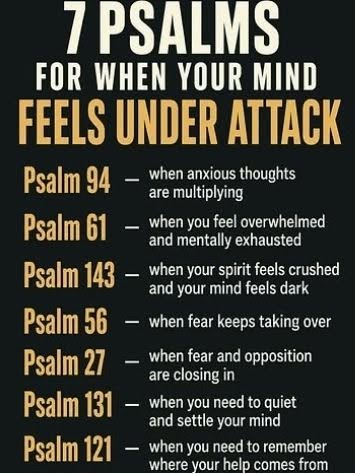
In Psalm 61:2, the psalmist David pleads with God, “Lead me to the rock that is higher than I.” At several times throughout the psalm, the author cries out to God and seeks His help. He asks God to “hear” his cry and “listen” to his prayer (Psalm 62:1). Through these exclamations, the psalmist recognizes that he cannot trust in his own strength and pleads with God to be his “rock.”
The psalmist calls out to God from a place of dire need: “From the ends of the earth I call to you, I call as my heart grows faint” (Psalm 61:2). The writer feels isolated and weary; he is fast losing hope. Then comes the petition: “Lead me to the rock that is higher than I” (Psalm 61:2). As he makes the request, David remembers the past help he has received from the Lord: “For you have been my refuge, a strong tower against the foe” (Psalm 61:3). God’s goodness in the past gives David faith to pray in the present difficulty.
When David asks God to “lead me to the rock that is higher than I,” he’s asking God to be his place of refuge. The Bible frequently refers to rocky formations as places of safety and security where one could hide from an enemy. In 1 Samuel 13:6, some Israelite men hid in rocky caves to flee from the pursuing Philistines. In Psalm 18:2, David refers to God as “my rock, in whom I take refuge.” When God is referred to as a “rock,” the picture is not of a small rock that someone could hold in his hand. Rather, God is like a large boulder or even a rocky mountain that serves as a foundation and place of refuge.
When the psalmist asks God to “lead me to the rock that is higher than I,” he’s also asking God to lift him up to a place of shelter and protection. Some understand the phrase “the rock that is higher than I” as a reference to the city of Jerusalem, which sits atop a mountain ridge (see Jeremiah 21:13). However, David could simply be asking God to lead him to God Himself, who is the “highest ground” one could seek. Both in biblical times and today, higher ground is considered safe and secure because it provides a strategic vantage point and is easily defended. Think of how people seek out higher ground when flood waters begin to rise or how combatants in warfare seek to take the higher ground from their enemy.
When we ask God to “lead me to the rock that is higher than I,” we’re acknowledging that He is our refuge and security and that He will provide us protection and shelter in times of trouble.
The Bible informs us that Lord God Himself is our rock, our fortress, and our deliverer. In Him, we can take refuge because He is our shield of protection, our horn of salvation, and our stronghold (Psalm 18:2). Over and again, Psalms compares God to a high and strong tower of protection and a shelter where His people can safely hide. But Proverbs 18:10 reveals a similar truth about God’s name: “The name of the LORD is a strong tower; the righteous man runs into it and is safe” (ESV).
In ancient times, a person’s name was much more than a random identifier or title. A name expressed the person’s nature and individual attributes. Thus, God’s name represents His essential character and authority. The person of God and the name of God cannot be separated.
The Lord’s name is a strong tower because the infinite heights and depths of His person, presence, and power are apprehended in that name. The righteous—those who are made right with God through a relationship with Jesus Christ—can run to Him in all His revealed perfection, faithfulness, power, authority, mercy, and love, and be set on high, barricaded inside His tower of protection, safe from all harm.
The name of the Lord is equivalent to the Lord Himself. It speaks of the revealed essence of God or the revelation of Himself in the history of salvation. The Lord shows Himself faithful and trustworthy to all who confide in Him: “From the ends of the earth, I cry to you for help when my heart is overwhelmed. Lead me to the towering rock of safety, for you are my safe refuge, a fortress where my enemies cannot reach me” (Psalm 61:2–3, NLT). The ESV renders the phrase “for you have been my refuge, a strong tower against the enemy” (verse 3). The name of the Lord is a strong tower because He is our defense. As we discover what God has revealed about His character, we can trust in Him (Psalm 91:2).
The name of the Lord and the character of God are interchangeable phrases. David said, “Those who know your name trust in you, for you, LORD, have never forsaken those who seek you” (Psalm 9:10). God makes His character known to us through His Word, through the person of Jesus Christ, and through the multi-faceted revelations expressed through His many names.
As Elohim, He is Creator; as Yahweh, He is the covenant-keeping, eternal I AM; as El Shaddai, He is the all-sufficient, all-powerful, God Almighty; as Jehovah Jireh, He is our Provider; as Yeshua, He is Savior. He is the Good Shepherd, who leads, guides, and protects; He is the Lamb of God, who lays down His life for us; He is Jesus, the Incarnate Son and Christ the Risen Lord; and He is the eternal, glorious, highly exalted, King of Heaven! Psalm 8:1 rightly acknowledges, “LORD, our Lord, how majestic is your name in all the earth! You have set your glory in the heavens.”
The name of the Lord can also be understood as His nature representing itself. One aspect of that nature is a strong, high tower offering a citadel of safety capable of holding off every hostile attack. Into this tower, the righteous can run and hide, safely guarded above all danger: “For in the day of trouble he will keep me safe in his dwelling; he will hide me in the shelter of his sacred tent and set me high upon a rock” (Psalm 27:5).
The name of the Lord is a strong tower because it is capable of safeguarding all who call upon that name. When the prophet Joel foresaw the Lord’s return, he saw a terrifying day of judgment and terror. Yet he declared, “And everyone who calls on the name of the LORD will be saved” (Joel 2:32). That same promise of salvation in the name of the Lord echoes in the New Testament (Romans 10:13; Acts 2:21). When we call upon the name of the Lord, we call upon God Himself.
The Lord’s name signifies everything that God is in Himself—His compassion, lovingkindness, mercy, grace, power, judgment, holiness, perfection, knowledge, and more. Everyone who knows and trusts in Him discovers that He is indeed a strong tower.
For the soul in need of restoration, Psalm 23 is perhaps the most comforting place to turn in all the Bible. King David, who had tended his father’s flocks as a boy, had come to know God as the shepherd of his life. In Psalm 23:3, David declares of the Lord, “He restores my soul. He leads me in paths of righteousness for his name’s sake” (ESV).
David wrote this psalm during a time of spiritual renewal or revival. “He refreshes my soul,” says the New Living Translation; “He renews my life,” affirms the Christian Standard Bible. Like a sheep who lacks the typical animal sense of direction, David had lost his way. He had wandered off the right path.
But here, David affirms, “He leads me in the paths of righteousness.” The primary jobs of the shepherd in pasturing his flock were to lead the sheep in the right way, to food and water, and to fend off predators. The shepherd was responsible for the welfare and safety of the sheep.
The word paths in Psalm 23:3 refers to one’s “course of conduct.” The word for “righteousness” in the original language means “adhering to moral standards like honesty, justice, and uprightness.” Like a shepherd guides his sheep along the right way, God effectively leads His people on the correct path by His Word and through the Holy Spirit’s guidance (Psalm 19:7; 119:105; Isaiah 59:21; 63:11–14; Romans 8:14 ). God does all this “for his name’s sake” or, in other words, to bring honor and glory to His name.
In ancient Israel, one’s name was inseparably linked with his reputation and standing. God leads us in paths of righteousness because He is a righteous shepherd: “For you are my rock and my fortress,” David acknowledged, “and for your name’s sake you lead me and guide me” (Psalm 31:3, ESV).
In Psalm 5:8, David prayed, “Lead me, LORD, in your righteousness because of my enemies—make your way straight before me.” As our life guide, the Lord assures us of faultless leading in straight paths. He is the ultimate companion for our journey. Like a professional travel guide, He stakes His name and reputation to guarantee our protection and safe arrival at the promised destination (Psalm 23:6).
The “paths of righteousness” depict the journey that leads to eternal life (Psalm 16:11). Proverbs 12:28 assures, “There is life in the path of righteousness, and in its path there is no death” (CSB). The Lord watches over those who walk on these paths (Psalm 1:6). As the proverb says, “The path of the righteous is like the morning sun, shining ever brighter till the full light of day” (Proverbs 4:18).
Believers are made righteous by faith in Jesus Christ (Romans 1:17; Galatians 3:11; Ephesians 2:8–9). By faith, we enter into a relationship with the one true God through Jesus Christ, His Son. Through the Holy Spirit, our Good Shepherd leads us on paths of righteousness (2 Corinthians 5:7; John 17:3; 1 John 2:25).
Sheep are known to stray from the path, and so are Christians. Yet, even if a believer falls into sin, as David did with Bathsheba (2 Samuel 11:1—12:15), the Lord is committed to leading him back to the right path. The Good Shepherd goes after the one lost sheep (Luke 15:1–7). The Father waits for the prodigal son to return (Luke 15:11–32). The Lord shows us our wandering ways so that we can repent and have our souls refreshed and restored. “If we confess our sins, he is faithful and just and will forgive us our sins and purify us from all unrighteousness” (1 John 1:9).
The disciple Peter is an excellent example of a straying follower who was pursued by the Good Shepherd, Jesus Christ our Lord (Luke 22:58–62). After he fell, Peter, like David, was forgiven and restored by the Lord (John 21:15–19).
According to Scripture, paths of righteousness are the safest roads to travel (Proverbs 4:11–12; 10:2, 9). These paths are ultimately avenues of safety, wisdom, justice, right living, integrity, and eternal blessings (Isaiah 42:16; Psalm 119:35; Proverbs 8:20; 11:3). They are “ways of pleasantness” and “paths of peace” (Proverbs 3:17).

Tea Time Manna
This is what the Lord says — your Redeemer, the Holy One of Israel: “I AM the Lord your God, who teaches you what is best for you, who directs you in the way you should go.”
—Isaiah 48:17
Don’t you sometimes long for the pillar of fire at night and the cloud by day to guide us as we make our way through life? God gave these blessings to the Israelites during their wilderness wanderings (Exodus 13:21-22; Nehemiah 9:19-21). They never had to doubt God’s presence was with them and his care was over them. Then I remember God’s promised and abiding presence with us as followers of Jesus. This abiding presence is the Holy Spirit (John 7:37-39; Romans 8:14). The Spirit’s presence is coupled with the promise that God will never leave or forsake us (Romans 8:38-39; Hebrews 13:5-6). As we seek God’s presence and honor his character, he will get us where we need to be to do his will. We can be assured that he will work in our lives what is most beneficial for us in this life and the next (Romans 8:28). Yes, the Lord is our God and Redeemer, and he directs us in the way we should go!
Prayer
O heavenly Father, please guide each of us to the places you want us to be, to the ministries in which you want us to serve, and to the people you most want us to touch and influence. Please, dear Father, capture each of our hearts to do your work and help us never lose sight of your abiding presence now, and the future we have with Jesus when he comes in glory.* In Jesus’ name, we pray. Amen and Amen
NEWS MANNA –
Vice President of the USA JD Vance Says The Antichrist May Be Walking Among Us – Could He Be Right?
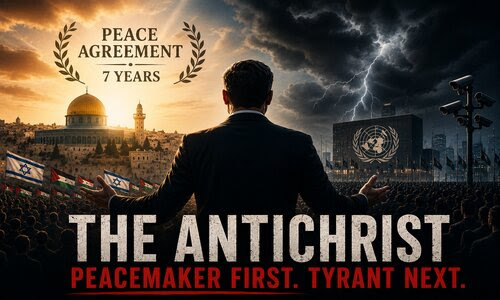
Vice President JD Vance made a remarkable comment this week that is certain to catch the attention of anyone who studies Bible prophecy.
During a lengthy conversation with Christian podcaster Bryce Crawford, Vance discussed his lifelong fascination with the end times and admitted that he does not know whether we are actually living in the final days described in Scripture.
But then he went further.
“There are, like, things about the world that make me feel, like, not shocked if the Antichrist was walking among us,” Vance said, while cautioning that he tries not to become overly focused on such speculation.
Vance pointed particularly to developments surrounding artificial intelligence, describing what he sees in parts of the technology world as having a strange spiritual darkness surrounding it. Yet his larger observation raises a fascinating question.
Could the Antichrist actually be alive today?
From a biblical perspective, the answer is certainly possible.
That does not mean we should start searching photographs of politicians, billionaires or world leaders trying to identify him. Christians have been doing that for generations, usually with embarrassing results. But if the prophetic events described in Daniel, 2 Thessalonians and Revelation are approaching, then the man who will eventually fulfill this role would obviously have to be alive before he is revealed to the world.
And Scripture gives us something of a profile by which this coming leader can eventually be recognized.
The Antichrist Will Be A Real Person
The Bible describes a spirit of antichrist already operating in the world, but it also points toward a specific individual who will emerge during the closing chapter of human history.
Daniel describes an extraordinarily powerful ruler. Paul calls him the “man of lawlessness” and “son of destruction.” Revelation presents him as the Beast whose authority eventually reaches across nations and peoples.
This is not merely an impersonal political system. Scripture repeatedly describes an individual who speaks, acts, deceives, makes agreements, persecutes God’s people and ultimately exalts himself against God.
But here is where our popular image of the Antichrist may lead us astray.
He may not initially look anything like the monster people expect.
He Will Initially Appear To Have Answers
Many Christians imagine the Antichrist arriving as an obviously evil dictator demanding that everyone worship him.
That comes later.
His initial rise appears far more subtle.
Daniel describes a leader who gains tremendous influence through intrigue and deception. Daniel 8:25 even describes destruction coming “by peace” in the King James rendering. Most significantly, Daniel 9:27 describes a coming ruler who will “confirm a covenant with many for one week.”
In Daniel’s prophetic framework, interpreters understand that final “week” as a seven-year period. Because the prophecy centers upon Daniel’s people, Jerusalem, the sanctuary and the restoration and eventual interruption of sacrifice, the covenant is commonly understood as a major agreement involving Israel and “many” other parties or nations.
That detail is enormously significant.
The Antichrist does not simply appear on the world stage announcing himself as a dictator. His rise is associated with a covenant that apparently provides some measure of political or religious security and stability involving Israel.
In other words, the man who eventually becomes history’s greatest tyrant may first become famous as a peacemaker.
And consider how attractive such a figure could become in our world.
Humanity is exhausted by war. The Middle East has endured generations of bloodshed. Russia and Europe remain locked in dangerous confrontation. Nuclear powers threaten one another while nations spend enormous sums preparing for conflicts they desperately hope never occur.
People don’t want another war.
They want someone who can stop them.
Imagine, then, a leader emerging during an international crisis who accomplishes what everyone else has failed to achieve. He brings hostile governments to the table. He provides security guarantees. He negotiates agreements previously considered impossible. Perhaps he resolves disputes surrounding Israel and its neighbors that generations of diplomats could not solve.
The world would not necessarily view such a man as evil.
It might view him as indispensable.
The Man The World Has Been Waiting For?
This is one of the great ironies of Bible prophecy.
The world’s ultimate tyrant may initially be celebrated as its greatest problem solver.
He may speak about peace, cooperation, stability and security. He may appear uniquely capable of bringing order from chaos.
And successful deception requires appearing to be something you are not.
The peace eventually collapses.
Daniel says that halfway through the seven-year period — after three and a half years — this ruler breaks the covenant and brings sacrifice and offering to an end. Jesus later points His disciples back to Daniel’s prophecy when He warns about the coming “abomination of desolation” standing in the holy place.
Revelation describes this latter period as an extraordinary time of persecution and satanic authority. The Beast is given authority for 42 months — three and a half years — while Paul says the “man of lawlessness” will ultimately exalt himself “above all that is called God” and present himself as God.
The implications are striking. The prophetic timeline moves from covenant to betrayal, from apparent peace to persecution, and from a leader celebrated for bringing stability to a ruler demanding allegiance and worship.
The peacemaker finally reveals himself as the tyrant.
A World Increasingly Ready For Such A Leader
This is where Vance’s question becomes particularly relevant.
We cannot know whether the Antichrist is presently alive. Scripture gives us no license to identify someone before the prophetic markers are present.
But we can observe that the world described by prophecy is becoming technologically and politically easier to imagine.
We now possess global communications capable of projecting one leader instantly before billions of people. Artificial intelligence can influence information on an unprecedented scale. Digital currencies and payment systems make previously unimaginable economic controls technically possible. Biometrics and digital identification increasingly connect individuals to centralized technological systems.
Meanwhile, international instability is creating enormous demand for security and leadership.
None of these things individually fulfills Revelation.
AI is not the Antichrist. Digital ID is not automatically the Mark of the Beast. A Middle East peace agreement is not necessarily Daniel’s covenant.
But collectively they demonstrate something remarkable: the technological and geopolitical architecture necessary for many end-times scenarios no longer sounds like science fiction.
Don’t Look For The Obvious Villain
Perhaps the most important lesson is that Christians should stop assuming the Antichrist will initially look like the Antichrist.
If Scripture portrays him as deceptive, persuasive and politically successful, the world’s first reaction to him may not be fear.
It may be relief.
After years of wars, economic turmoil, political division and constant threats of something worse, humanity could become desperate for someone promising peace and stability.
That is why the biblical warning is ultimately about deception.
JD Vance may be right that the individual who will someday fulfill these prophecies could already be walking among us.
He could be young. He could currently be unknown. He could already occupy some position of influence. Or his appearance could still be generations away.
We simply don’t know.
What Scripture tells us is far more important.
When he finally emerges, don’t expect the world to immediately recognize a monster.
It may initially believe it has finally found a peacemaker.
a Picture of the Great Tribulation – Canada’s Judeo-Christian Culture Under Attack: Churches Burn, Jews Flee
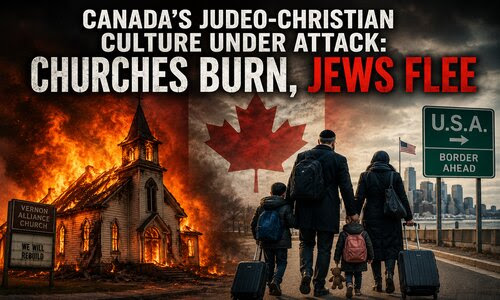
Another Canadian church has gone up in flames.
On Monday evening, fire tore through Vernon Alliance Church in Vernon, British Columbia, causing significant damage and bringing roughly 35 firefighters from several departments to the scene.
As of Tuesday, investigators had not determined the cause of the fire but the sight of yet another Canadian church engulfed in flames is difficult to ignore because it comes against a much larger and deeply troubling backdrop.
Just a week earlier, the historic Saint-Simon Catholic Church in New Brunswick was destroyed by fire. Built more than a century ago and long considered a landmark of the local Acadian community, the wooden church was reduced to ruins. In that case, authorities determined that the fire had been deliberately set, and 68-year-old Gilles Mallet was charged with arson.
Police have not said the Saint-Simon attack was religiously motivated. Nevertheless, it becomes another entry in Canada’s disturbing recent history of churches being burned or vandalized.
Since 2021, dozens upon dozens of Canadian churches have been damaged or destroyed, with some investigations putting the combined number of arson and vandalism incidents well above 100. The Macdonald-Laurier Institute reported in 2025 that arson targeting houses of worship had doubled following the controversy surrounding Canada’s residential schools and that more than 96 percent of the crimes examined remained unsolved.
Now an independent forensic investigation has been launched into the broader wave of attacks against churches and synagogues.
Not Every Fire Is Persecution
Accuracy matters here.
Not every burning church was deliberately targeted because it was Christian. Some fires remain unexplained, some incidents involve vandalism rather than arson, and motives differ from case to case. The cause of the Vernon Alliance Church fire remains unknown, while authorities have specifically said they have no evidence at this point that the Saint-Simon arson was religiously motivated.
But acknowledging those distinctions should not require Canadians to ignore the larger pattern.
Imagine if more than 100 buildings associated with virtually any other identifiable minority community had been burned or vandalized within a few years. Would the country simply shrug its shoulders?
Conservative leader Pierre Poilievre recently argued that attacks against Christians have received far less attention than they deserve, insisting that Canadians of every religion should be able to worship without fear.
That shouldn’t be controversial.
But Canada’s Christians aren’t the only religious community asking uncomfortable questions about what has happened to their country.
Jewish Canadians Are Looking For The Exit
At the same time churches are being vandalized and burned, Canada is confronting an extraordinary surge of antisemitism.
Since the October 7 Hamas massacre, Jewish schools, synagogues, businesses and families across Canada have faced bomb threats, vandalism, intimidation and violence. According to recent reporting, B’nai Brith Canada recorded 27 violent antisemitic incidents during just the first half of 2026–nearly three times the number recorded during all of 2025.
The situation has become serious enough that American Christian lawmakers and religious leaders are asking President Donald Trump to help Jewish Canadians leave.
The National Association of Christian Lawmakers and its partners recently appealed to the Trump administration to establish a lawful expedited pathway for Jewish Canadians who can demonstrate persecution or a credible fear for their safety. More than 2,000 Jewish Canadians have reportedly expressed interest in relocating because of security concerns.
Trump amplified the proposal on social media, although his administration has not announced an immigration program or formally committed to implementing one.
Think about what that means.
We are not talking about Jewish families attempting to escape Iran, Yemen or some openly antisemitic dictatorship. We are talking about Jews considering leaving Canada for the United States because they increasingly question whether their children, synagogues and communities are safe.
For a Western democracy that prides itself on tolerance, diversity and inclusion, that should produce some serious national soul-searching.
What Happened To Canada’s Judeo-Christian Heritage?
Christianity and Judaism are obviously distinct faiths, but together their biblical heritage profoundly influenced the civilization Canada inherited.
Ideas about the dignity of the individual, moral accountability, charity, family, religious liberty and the sanctity of human life did not emerge in a cultural vacuum. They developed over centuries within a civilization deeply influenced by the Bible.
Yet modern Canada has increasingly treated that inheritance as something embarrassing to be discarded rather than something worth preserving.
Christian beliefs that would have been considered completely ordinary only a generation ago are increasingly portrayed as intolerant. Churches have watched their cultural influence collapse while biblical convictions on marriage, sexuality and the sanctity of life have become deeply unpopular within many Canadian institutions.
Meanwhile, another ancient hatred has returned with remarkable speed.
After October 7, demonstrations supposedly directed against Israeli government policy repeatedly crossed into open hostility toward Jews and Jewish institutions. Synagogues required increased security. Jewish schools were targeted. Businesses were vandalized. Jewish Canadians found themselves confronting a level of hostility many probably never imagined they would experience in their own country.
These developments do not all have the same cause, and they should not be artificially combined into a single conspiracy.
They do, however, reveal something about Canada’s changing culture.
Tolerance Cannot Mean Tolerating Intolerance
Canada has spent decades telling the world that tolerance is one of its defining national virtues. But tolerance is meaningless if it protects fashionable beliefs while religious minorities become increasingly afraid to practice unfashionable ones.
Christians should be able to worship without wondering whether their church will become another statistic. Jewish parents should be able to send their children to school without armed security becoming a fact of life. Jews should be able to wear a Star of David publicly, and Christians should be able to express biblical convictions publicly, without intimidation.
Religious liberty only works when it applies to everyone.
The flames at Vernon Alliance Church may ultimately prove to have nothing whatsoever to do with religious hatred. Investigators should determine the facts, and Christians should resist the temptation to claim persecution where evidence does not establish it.
But Canadians should also resist the opposite temptation: pretending nothing significant is happening.
Churches have burned. Synagogues and Jewish schools have been threatened and attacked. Antisemitic incidents have surged. And now thousands of Jewish Canadians have reportedly expressed interest in leaving while American lawmakers discuss ways of helping them do so.
A civilization rarely realizes what it has lost until much of it is already gone.
Canada would do well to remember that the Judeo-Christian inheritance it has spent decades pushing toward the margins helped produce the very principles of religious liberty and tolerance that Canadians now claim to cherish.
If Christians increasingly watch their churches burn while Jews increasingly look for the exit, perhaps the question Canada should be asking isn’t simply who is responsible for each individual incident.
Perhaps it is time to ask what kind of country Canada is becoming. Is the World Next ?

TruLight TV – God wants you to live
The pursuit of greater art-making, storytelling, graphic design, or the blaring voice within will have us seeking approval at times from the most unfulfilling places. It’s only when you steady yourself and quiet the false thoughts that you get to hear God speak in the most peaceful ways. Listen now to hear how God wants you to live to the fullest despite all the chaos around you. Today’s guest artist on Gospel Music USA – Lauren Talley is one of Christian music’s most dynamic talents and has inspired a generation of young people to serve the Lord. She has recorded seven solo albums, including 2019’s unprecedented release of two albums simultaneously, “Glorious God: Songs of Worship and Wonder,” and “Loudest Praise: Hymns Of Mercy, Love and Grace.” Her 2017 album, “The Gospel,” reaches the number one position on Billboard’s southern gospel chart. Enjoy the music and message and share this video with your friends.
Today on TruLight Radio XM
TruLight Radio XM 24/7
Program
GMT / UTC +2
Monday To Fridays
00:15 Words to Live By Testimonies
01.15 Science Scripture and Salvation
02.15 Ground Works
04.00 Gospel Concert of the Day
05.00 The Daren Streblow Comedy Show
5:55 It is Today devotional
6:00 Gaither Homecoming Morning Show
7:15 Discover the Word
8.15 Destined for Victory
8:55 Science Scripture and Salvation
9:00 Holy Spirit Hour – Normally Sermons
10:15 Hope of the Heart
11:15 Unshackled
11.45 Words to Live By
12:15 Truth for Life
13:15 Living on the Edge with Chip Ingram
14:15 Focus on the Family
15:00 Kids Hour
16:00 In Touch with Dr. Charles Stanley
16:30 Groundwork
17:15 Live in the Light
18:15 Renewing your Mind
19:00 Gaither Homecoming Show
20:15 Growing Hope
21:15 Adventures in Odyssey Radio Drama
21:45 Bible Reading
22:15 Night-sounds
23.00 Good Old Country Gospel / Rhema Gospel Express
VISIT THE WEBSITE
https://trulightradioxm.org.za
TruLight Ministry News – EXTRA MANNA
TruLight Ministries orders from God since 2012 . Teach Them , Comfort Them and Warn Them!
Artist Liners
Healing Truths.
End Time Articles.
Share this Feeding of Manna with your Friends and Family. just click on the Social Media icon and share This Manna with your Friends and Family. just click on the Social Media icon and share !